Why Touring Breaks Even The Most Resilient Musicians and Performing Artists (And What Your Nervous System Actually Needs)
Let’s call her Sonia. She had been looking forward to this tour for months. The repertoire was strong, the orchestra was good, and Italy in spring is not a hardship by any measure. By day four she was waking at 3am in a different hotel room, heart racing, running through the next day's programme in her mind before she had even worked out which city she was in. By day seven she was rationing her energy in ways she had never needed to do before. By the time she landed home, she felt flattened in a way that a weekend's sleep would not touch.
She is not unusual. I hear versions of this story regularly from the musicians, singers and other touring performing artists I work with. Touring is one of those experiences that looks, from the outside, like a privilege. And it absolutely is and many people dream of it. But it is also, from the inside, one of the most sustained physiological and psychological demands a performer will face.
What makes it so hard is not any single thing. It is the accumulation.
You know all the standard advice but is it sufficient?
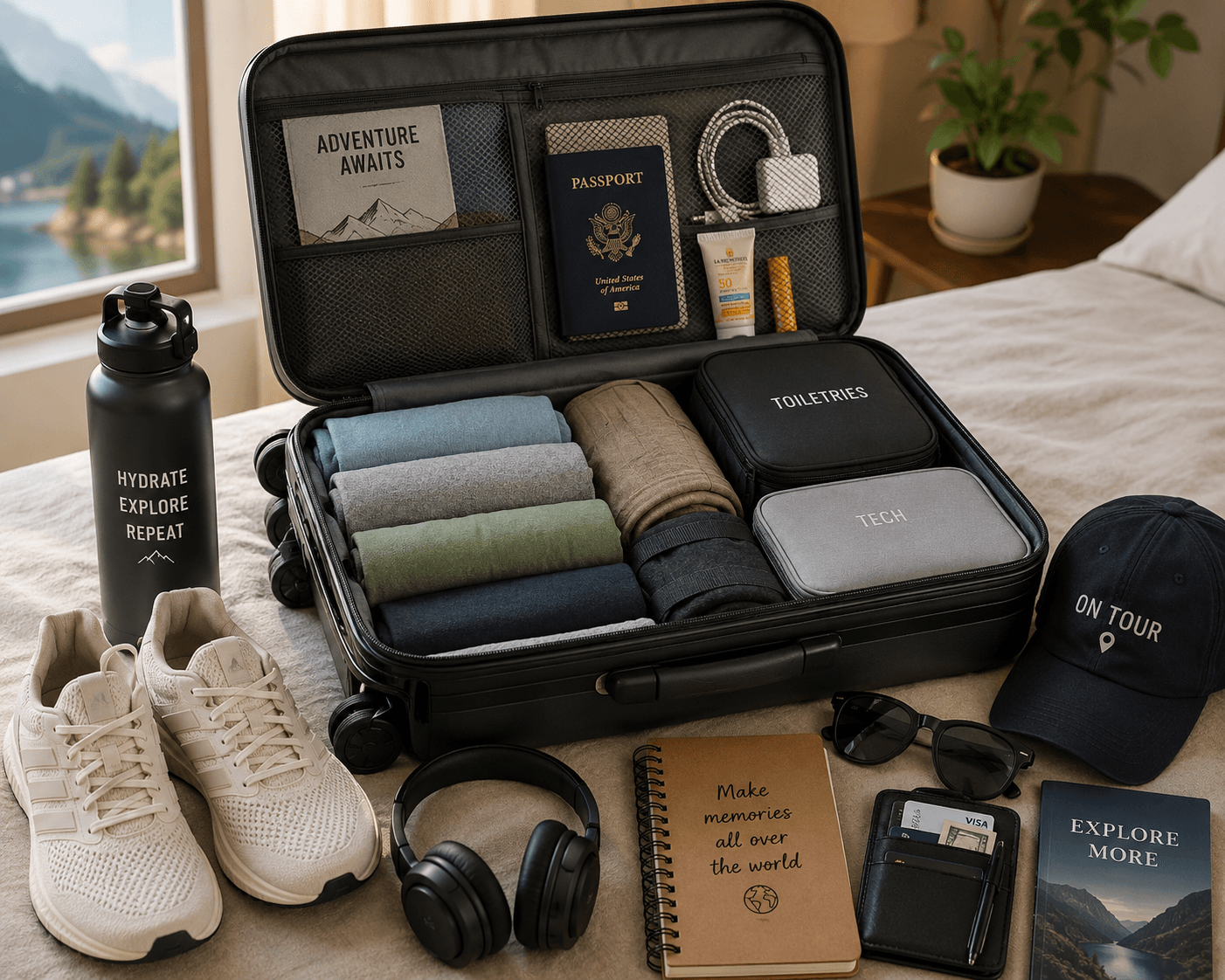
If you search for advice on managing stress whilst touring, you will find a fairly consistent list. Exercise regularly. Eat well. Stay connected with people at home. Maintain a sleep routine. Limit alcohol. These are not wrong. They are just insufficient.
They treat touring stress as a logistics problem. If you optimise the inputs, you can manage the outputs. Pack the right things, build the right habits, and you will be fine.
But the stress of touring is not only a logistics problem. It is a nervous system problem, where you may feel more alert, more on edge (even when you don’t fully notice it) in unfamiliar environments. And your nervous system may need a bit more than a well-organised suitcase.
Here is what is actually happening. When you are on tour, your nervous system never fully disengages. There is no grounding. No routine. No place that is yours. The environment changes constantly, the demands are high, and the moments of genuine recovery are rare. Your body registers this as a low-level, chronic threat. Not dramatic. Not the panic you might feel before a difficult concert. Just a steady, unrelenting activation that slowly depletes your capacity to regulate.
Add to this the particular texture of touring life for a musician: the social closeness without genuine intimacy, the post-gig adrenaline that leaves you wired at midnight in a silent hotel room, the gap between the intensity of performance and the flatness of the hours that follow. Research on touring professionals shows rates of depression and anxiety that are significantly higher than the general population, and a consistent pattern of substance use as a coping mechanism, not because musicians are reckless, but because the nervous system is looking for any available route to decompression.
The advice to limit alcohol does not address why the bottle of wine at midnight feels necessary. The advice to exercise does not address why the thought of a morning run, when you are running on four hours of broken sleep, feels almost offensive.
A different way of thinking about it
In my clinical work, I often ask performers to shift from asking "what am I doing wrong?" to asking "what does my nervous system actually need right now?"
This is not a small shift. Most high-achieving performing artists have been trained, explicitly or implicitly, to override their body's signals. Push through. Stay focused. Deliver. The discipline that makes you a professional is, in part, a practised capacity to ignore what your body is telling you.
On tour, that same discipline becomes a liability. Because the signals your body is sending, the fatigue, the irritability, the 3am wakefulness, the emotional flatness, are not failures of character or professionalism. They are accurate information. Your nervous system is telling you that it is not recovering between demands, and that without some form of genuine regulation, it will continue to escalate.
Genuine regulation does not mean relaxation in the conventional sense. It does not require a yoga mat, a meditation app, or an hour of silence. What it requires is a signal to your nervous system that you are safe. That the performance is over. That the threat has passed. That you can, even briefly, stop scanning.
This is why the backstage environment matters so much, and why the transition between performance and rest is one of the most psychologically significant moments in a touring musician's day. The adrenaline that made you sharp on stage does not simply switch off when you walk into the wings. Your body is still in performance mode. Without a deliberate shift, it will stay there.
What the research and clinical experience both point toward
There is good evidence for a few things that work in real touring conditions, by which I mean in the actual constraints of a schedule that offers you a hotel room, forty minutes, and probably too much adrenaline.
Short, deliberate transitions matter more than long recovery practices. Even ten minutes of genuine disengagement, walking rather than scrolling, a shower with the specific intention of letting the performance go, can shift your nervous system state in ways that compound over days.
The exhale is more powerful than the inhale. This is not metaphorical. Lengthening the out-breath activates the vagal brake, the parasympathetic pathway that signals safety to the body. One long, slow breath out, longer than the breath in, does something physiologically real. It is not a magic fix, but it is a reliable intervention that works in real time.
Naming what you are experiencing, even briefly and privately, reduces its intensity. Research on affect labelling consistently shows that putting words to a physical state modulates the threat response in the brain. "I am wired after the concert and my body has not caught up" is not the same as lying awake in a spiral of vague dread.
And belonging matters. Not the social performance of being part of a touring company, but genuine moments of connection, of being known, of contact with people who are not your colleagues. The loneliness that researchers consistently identify in touring professionals is not just uncomfortable. It is physiologically costly. Brief, real contact with people outside the bubble provides something the body needs.
If any of this sounds familiar
The stress of touring does not mean you are doing it wrong, or that you are not cut out for this life, or that you should have prepared better. It means you are a human nervous system in a genuinely demanding environment, doing its best.
If you want to understand how performance pressure specifically shows up in your body, the free Stage Fright Symptom Profiler and FBI Backstage Reset are a good place to start. They take about five minutes and give you something specific to work with. I designed this exercise thinking of the moments prior to going on stage where the I in the FBI is about the INTENT. In a wind down routine you can choose the intent to me: ‘feel safe’, ‘come down’ or ‘transition to sleep’. I hope it helps a little bit.
Get the free FBI Reset and Stage Fright Symptom Profiler here.

HI, I’M DR. MAJA JANKOWSKA...
a Clinical and Counselling Psychologist specialising in the mental wellbeing of stage performers. I support musicians, singers, actors and other high-achieving creatives in developing psychology-informed mental skills so they can perform with confidence, manage pressure and maintain resilience without burnout.
With 23 years of clinical, academic and research experience – including expertise in CBT, EMDR, trauma (PTSD & C-PTSD) and performance psychology – my approach is grounded in robust scientific evidence.
My aim is to safeguard your passion, longevity and emotional wellbeing in one of the most demanding creative industries.
If you’re seeking free resources, expert guidance on performance anxiety and self-doubt, or support in achieving peak performance whilst staying mentally strong, you’re in the right place.



JOIN MY MAILING LIST